Before you bid

Read the bottle
before you buy it

A lot page is not an advertisement. It is a record of what we found when the bottle was in front of us: a set of photographs taken to the same standard every time, a panel of everything printed on the label, and a plain note of anything that is not perfect about it.

Read that record properly and there are no surprises when the box arrives. This page is about how to read it — what the photographs are showing you, what the fields in the panel mean, and what to do when something is still not clear.

Every bottle in our hands

Checked on our own table

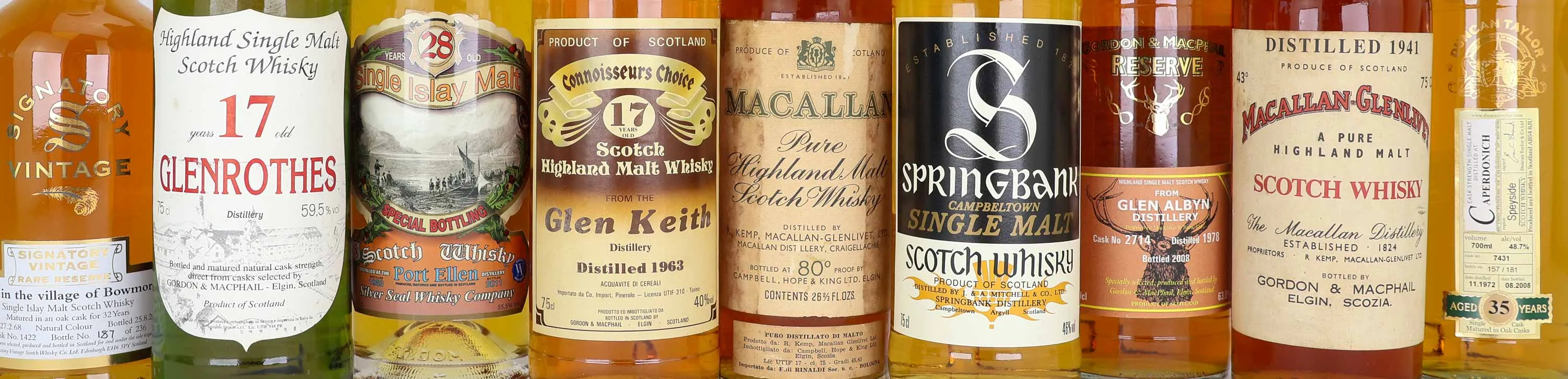
Front and back, every time

Plus a frame for anything unusual

Damage written down

Condition notes on the lot itself

Sold as seen and described

Which is why this page exists

What happens before you see it

Every bottle crosses
our table first

Nothing goes into a catalogue on the strength of a seller's description. Bottles come to Groningen, they are unpacked by the people who will later pack them for you, and what ends up on the lot page is what those people saw.

1

It arrives and is checked

The seal comes first: intact, and not tampered with. Then the fill level against the neck and the shoulder, the label, the capsule, the base of the bottle and the closure. If there is a tube or a box, that is checked too, because a damaged presentation box is part of what you are bidding on.

Anything we cannot stand behind never reaches you at all. It goes back to the seller instead of into the auction, which is a duller story than most people expect from a whisky auction and exactly the point.

2

It is photographed

Every bottle is shot under the same light in the same corner of the same room: the front and the back as standard, and then a frame of its own for anything that needs one — an old customs strip, a chip, a tear, a leaking closure. Very old and very valuable bottles get their base photographed as well.

That consistency is what makes the photographs worth studying. When two lots are shot the same way, a difference between them is a real difference and not a trick of the lighting.

3

It is written up

The label is transcribed into the specification panel — distillery, bottler, vintage, age, strength, cask, bottle number, volume — and everything that is not on the label goes into the description in plain words.

We do not write that a bottle is stunning. We write that the fill is at the upper shoulder, the label has a tear at the lower right, and the tube is missing. What you make of that is your business as a bidder.

One consequence of all this is worth saying out loud: a lot is sold as seen and described. The photographs and the description are the deal, so the half hour you spend on them before the closing evening is the most useful half hour of the whole auction.

How to look

The photographs are
the description

Every lot carries two photographs as standard — the front of the bottle and the back — and then as many more as the bottle gives us a reason for. That is the whole logic of the gallery: a fixed base that lets you compare one lot against another, plus a frame for anything that deserves to be seen on its own.

Move your mouse over the main image and a magnifier opens over it, showing the photograph at full size. On a phone, tap the image and pinch. Use it — the frames are shot at a resolution that rewards it, and most of what you want to know, including how high the whisky stands in the bottle, is visible at that magnification.

Here is what each shot is for, when it appears, and what an experienced bidder is looking for in it.

The front of the bottle

On every lot

The whole bottle, straight on and held against the light. It carries the front label, the shape of the glass, the capsule sitting on the neck and the colour of the liquid — and because it is shot against the light, it carries the fill level too. There is no separate photograph of the level: open the magnifier on this one and you can read it against the shoulder yourself.

It is also the shot that tells you what actually comes in the box. If a tube, a stopper, a booklet, a certificate or a wooden case is part of the lot, it is standing next to the bottle in this frame. If it is not in the photograph, it is not in the lot.

The back of the bottle

On every lot

Where the small print lives: the back label, the strength, the volume, the bottler's name and address, the cask and bottle numbers where there are any, and the codes printed on the glass or the paper. Everything in the specification panel was typed off these two photographs, and you can check every field of it against them.

Look at the state of the paper as well as the words on it. Fading, foxing, a torn corner, a ring from a damp shelf or a label that has been lifted and re-glued all show up here, and all of them move the price.

An old customs or tax seal

Whenever a bottle carries one

Older bottlings from Italy, France and Spain often carry a duty strip across the closure, and when one is there it gets a frame of its own. That is worth having close up, because it is the detail most often misread on the whole bottle.

A cut strip is not an opened bottle. Those bands are applied and cut by officials and say nothing whatsoever about the seal underneath. Seeing it properly, rather than as a smudge in the corner of a wide shot, is the point of photographing it separately.

Anything that is wrong with it

Whenever there is something

If something is the matter with a bottle it gets its own photograph, taken close and lit so the fault is obvious rather than tactful. A tear, a scuff, a stain, a leaking closure, a dented tube, a missing stopper: whatever it is, it is photographed and it is also written into the description.

These are the frames to look at hardest, because they are the ones a hopeful bidder skips. A lot with three damage shots is not a worse lot than one with none — it is a lot you know more about.

The base of the bottle

When the bottle earns it

Underneath a bottle sit the details that settle arguments: glass codes, mould marks, embossed dates, an importer's stamp, sometimes a batch number that appears nowhere else. Collectors of older releases use them to date a bottling to within a year or two.

We shoot it where it is going to matter — on the old bottles and the expensive ones, where a year either way changes what the lot is worth. On a recent bottling there is nothing under there worth your time, so we leave it out rather than pad the gallery.

So the number of photographs on a lot is information in itself. Two means a straightforward bottle with nothing to declare. Five or six means there was something we wanted you to see close up — which makes it a lot you know more about, not a lot with more wrong with it.

The panel under the photographs

Everything printed
on the label

Underneath the images sits a panel of properties, and every line in it was read off the bottle rather than copied from a catalogue somewhere. Where a field is empty it is because the label is silent on it, not because nobody looked.

Read the panel and the label photographs together. They should agree with one another down to the last digit, and on the rare occasion they do not, we would very much like to hear about it before the auction closes rather than after.

Distillery and bottler
Who made it and who put it in the bottle. An official bottling and an independent one from the same distillery are two different markets, so the panel always tells you which you are looking at, along with the bottling series where there is one.
Distillery status
Whether the distillery is still working. A closed distillery is marked as such, because a spirit from a place that will never make any more of it is judged on entirely different terms.
Vintage and bottling year
The year it went into the cask and the year it came out, whenever the label states them. Between them they give you the age even on bottles that never print one — and when we have calculated an age that way rather than read it, the panel says so.
Age
The age statement as printed. Plenty of good whisky carries none at all, which is a fact about the bottling and not a gap in our description.
Strength
The alcohol by volume, shown in degrees proof as well where that is how the label puts it. Bottles filled straight from the cask are flagged as cask strength.
Cask and outturn
The cask number and cask type where the label carries them, whether it is a single cask, how many bottles were filled from it and — on numbered releases — which one of them this is.
Volume
The size of the bottle. Worth a glance rather than an assumption: 70cl, 75cl and 50cl sit side by side in the same catalogue, and an old American export bottling is a different quantity of whisky to the one you were comparing it with.
Bottle and EAN codes
The codes printed on the glass and the label, where they exist. They are the fastest way to match a lot against a database entry and settle any doubt about which release you are looking at.

Quality and state

What we say
when something is wrong

Almost every interesting bottle has something the matter with it. It has been standing on a shelf since before you were collecting, it has moved house twice, and the label shows it. That is not a reason to leave it out of an auction — it is a reason to describe it properly.

So a lot page carries its faults as plainly as its virtues, in a fixed set of markings that mean the same thing on every lot in the catalogue. Learn to read them once and you can size up a lot in half a minute.

And if a marking is not there, that is information too: it means we looked and found nothing to report.

The bottle is still here

Every lot in a live auction is sitting in our building in Groningen. That makes "let me go and look" a real answer rather than a polite one, so if a photograph has not settled something for you, ask us.

Critical issues Read these first
The strongest marking a lot can carry, and it appears at the top of the page with a marker that pulses so it cannot be scrolled past. It is reserved for the things that would change your mind about bidding at all: a seal in question, a leak, a level that has fallen away, damage that goes beyond cosmetic.
Quality and state notes Every mark we found
The ordinary list of imperfections: a faded label, a scuffed tube, a torn box, a stained capsule, glue residue where a price sticker used to be. None of it stops a bottle being sold and all of it is written down, because the difference between a described flaw and an undescribed one is the difference between an auction and a disappointment.
Fill level Described, not measured
Given in the terms the trade uses — into the neck, upper shoulder, mid shoulder, low shoulder — and always visible in a photograph as well. A level that has dropped is normal in old bottles and abnormal in young ones, and reading it next to the bottling year tells you which of the two you have in front of you.
Tax stamp or customs seal Not a broken bottle
Marked on the lot when a bottle carries one. These strips are cut by customs officials and by nobody else, so a broken one has no bearing on whether the bottle is sealed. On older Italian and French bottlings in particular they are a good sign rather than a bad one.
Old corks and transport Worth knowing about
A cork that has spent forty years in a bottle can give way in transit even when it was sound on our table, and we say so on the lots where it is a real possibility. We pack for it as carefully as anybody can, but leakage in transport is one of the few things a shipment cannot be insured against.
Sold as seen and described What the phrase means
You are buying the bottle in the photographs, with the faults in the description, at the condition it is in today. That is why we would rather you asked a question you thought was obvious than let the hammer settle it — and why a bid, once placed, is binding.

Before you settle on a figure

Half an hour of reading
is worth a hundred euros

The photographs tell you what the bottle is. What they cannot tell you is what it is worth, whether the release is scarce or merely old, and whether the price on the screen is a bargain or an evening getting away from somebody. That part is homework, and there is a lot of it available for free.

Look the bottling up

Almost every bottling of consequence is catalogued somewhere, usually with photographs, tasting notes and a record of what other people have paid for it. Match the cask number, the outturn and the strength against what you are reading here, and the picture fills in quickly.

We keep a short list of the databases and communities we use ourselves. None of them are ours, none of them pay us, and all of them will tell you more about a distillery than a lot page ever could.

See what it made last time

Our own past results are open to everyone and they are the most honest guide there is to what a bottle fetches here. Search on a distillery or a bottling and you can see what comparable lots actually sold for, rather than what somebody hoped they would.

Pay attention to condition when you compare. A lot with a perfect label and a full tube is not the same lot as the one with neither, however identical the whisky inside them is.

Read the bid history

Every lot carries its own bid history, showing each bid with the date and time it was placed. It is worth a look before you decide on a maximum: a lot that climbed steadily over a week is behaving differently to one that jumped twice in the last hour.

The history is open to signed-in members. Bidders are never named — you see the bidding, not the bidders — and the same is true of your own bids on somebody else's screen.

Do the reading in the quiet days rather than on the closing evening. Once the last hours are running, the only useful question left is what your maximum is — and that is a far easier question to answer when you settled it days earlier with a database open in front of you.

When the page has not answered it

Ask us
while you still can

There is no such thing as a question that is too small. Is that a shadow on the label or a stain? Does the stopper still turn? What is moulded into the base of the glass? Would you take one more frame from the other side? We would far rather spend two minutes on any of those than have you find out from a courier.

Questions come to us rather than to the seller, which is deliberate: we are the ones with the bottle. Somebody can walk over to the shelf, pick it up and look, and you get an answer from the person who did that rather than a recollection from somebody who packed it a month ago.

Do it before you bid, though, and not after. A bid is binding from the moment it is placed, and the only sensible time to resolve a doubt is while it can still change what you do.

Worth asking about

  • Anything in the photographs you cannot interpret with the magnifier open.
  • The codes moulded into the glass or printed on the base, when you are dating a bottling precisely.
  • An extra photograph from an angle we have not shot — the base of the bottle included.
  • Whether a fault in the description is worse in the hand than it looks on a screen.
  • Anything at all where the answer would change your maximum.

And three you will not need to ask

  • Whether a box, tube, stopper, booklet or certificate is included: if it is part of the lot it is standing beside the bottle in the photograph.
  • The weight of a ceramic or an opaque decanter, which you will almost always find already in the description.
  • Whether two lots from the same auction can travel together: everything ships from our building, so they can.

During a live auction we answer as quickly as we can, but the last hours of a closing evening are the busiest of the month. Send your question in the quiet part of the week and you will get a better answer, sooner.

The things bidders ask first

Questions about
reading a lot

The rest of what people ask is indexed on our questions and answers page, and anything specific to a particular bottle is best sent to us directly — ask us and somebody will go and look at it.
The photographs look fine. Do I still need to read the description?

Yes, and it is the single most common reason somebody is disappointed. Photographs show a bottle at one moment from one angle; the description is where we put the things a camera does not capture well — a smell of leakage, a cork that moves, a box that has been repaired, a label that has been re-glued.

The two are meant to be read together. If they ever seem to disagree, stop and ask us before you bid.

What counts as a critical issue?

Anything that could reasonably stop you bidding: a doubt about the seal, an active leak, a fill level that has fallen away, damage that is structural rather than cosmetic. It is the marking we use most sparingly and the one we place most prominently, at the top of the lot with a marker that draws the eye.

A lot with a critical issue is still a real lot with a real price. It simply has to be bid on with open eyes, which is the whole reason the marking exists.

The fill level looks low. Should that put me off?

It depends entirely on the age of the bottling. Whisky escapes slowly through a cork over decades, so a level at the top of the shoulder on a 1970s bottle is completely ordinary and priced in by everybody bidding against you.

The same level on something bottled ten years ago is a different matter, and worth asking about. Below the low shoulder we do not catalogue a bottle at all, so anything you see in a live auction is at least above that line.

The customs seal is cut. Has the bottle been opened?

No. A customs or tax strip is a duty seal applied and cut by officials, and it says nothing whatsoever about whether the closure underneath is intact. Older bottlings from Italy, France and Spain very often carry one.

The seal that matters is the bottle seal itself. If that had been broken the bottle would never have made it into the catalogue in the first place.

Can I ask for an extra photograph?

Of course, and it is one of the more common things we get asked. The lots in a live auction are in our building, so an extra angle usually means somebody walking to a shelf with a camera.

Ask early in the auction rather than in the closing hours. The last evening is the busiest time of our month, and a photograph that arrives after the hammer helps nobody.

What does sold as seen and described actually mean for me?

That you are buying the bottle as it stands in the photographs, with the faults set out in the description, in the condition it is in now. Age, wear and imperfection are part of the object rather than a defect in the sale.

It does not mean we shrug when something is wrong. If a lot arrives and does not match what we published, tell us straight away and we will look at it with you — that is a mistake on our side, not a matter of condition.

I bid on the wrong lot. Can I take it back?

A bid is binding once it is placed, because the seller and every other bidder are relying on it. That is also why we ask you to settle on your maximum before the closing evening rather than during it.

The one exception is an obvious mistake — a nought too many, a bid on a neighbouring lot. Contact us as soon as you notice and we will sort it out; the sooner you do, the more that can be done.

Do you guarantee that a bottle is authentic?

Every bottle passes through our hands and anything that does not add up is refused rather than listed — the label, the closure and the glass all have to agree with one another and with the year they claim to come from. That judgement is ours and we exercise it every week.

What we will not do is guess in public. If we have any hesitation about a bottle it does not reach the catalogue, and if you have one about a lot you are watching, tell us and we will look again.

You have read it
properly. Now bid.

Once you know what the bottle is and what it is worth to you, the rest takes about ten seconds: one maximum bid, and the system watches the lot on your behalf until the auction goes quiet.